

Whitepaper
Medical Imaging AI Whitepaper
Applications of imaging technology in healthcare in China (2026): technology stack, clinical scenarios, regulatory compliance and practice — from image acquisition and AI-assisted diagnosis to early GI cancer screening.
Full text
Medical Imaging AI Whitepaper
Applications of Imaging Technology in Healthcare in China
Executive summary
Medical imaging AI refers to artificial intelligence technologies — primarily deep learning — that automatically analyze and assist interpretation of medical images such as CT, MRI, X-ray, ultrasound, endoscopy and pathology. Core capabilities include lesion detection, localization, quantification, classification, quality control and assisted report generation. In China, medical imaging AI has moved from research into scaled clinical deployment: dozens of AI medical device software products have received registration approval from the National Medical Products Administration (NMPA), and radiology departments, endoscopy centers, pathology departments and primary-level institutions are progressively adopting AI-assisted diagnosis.
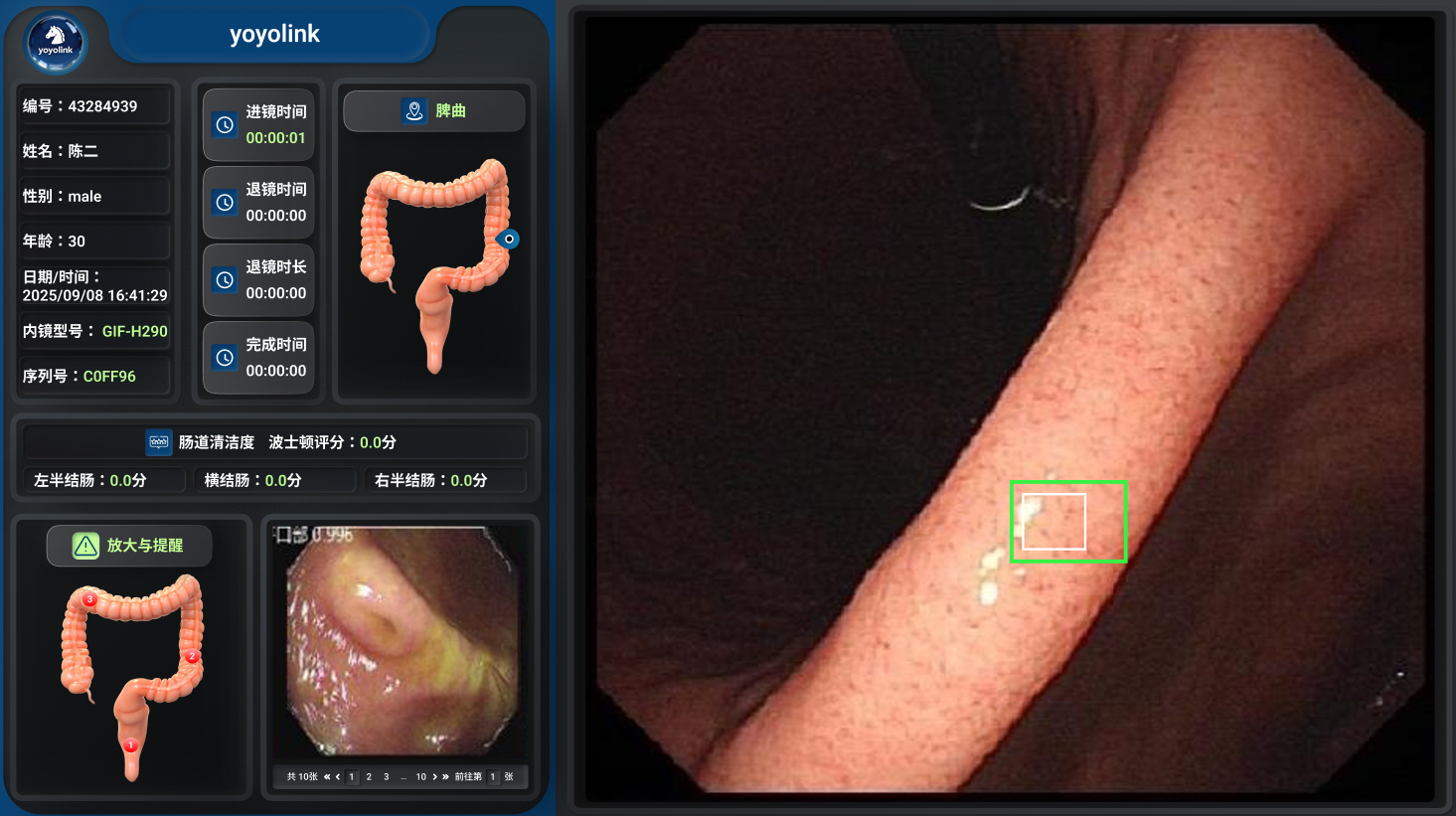
This whitepaper reviews the technology stack, application scenarios, deployment characteristics, regulatory compliance, challenges and a practice case of imaging technology in Chinese healthcare, and introduces the yoyolink AI GI Endoscopy System (hardware + software) as an endoscopic imaging example.
1. Market and policy context
China is among the countries with high incidence of gastric and colorectal cancer. International Agency for Research on Cancer (IARC) data has long shown that gastrointestinal tumors account for a significant share of new cancer cases in China, making early diagnosis and treatment the key to better outcomes.
Imaging data is estimated to account for more than 70% of hospital data, and radiologists face sustained pressure from high reading volumes and high accuracy requirements. With the advancement of tiered diagnosis and treatment, medical consortia (医联体/医共体), regional imaging centers, smart hospital initiatives and DRG/DIP payment reform, "AI + medical imaging" has become an important tool for cost reduction, efficiency and quality improvement in primary care.
Relevant policy directions include: the "Healthy China 2030" plan explicitly calling for early cancer diagnosis and treatment; the 14th Five-Year Plan for the pharmaceutical industry listing AI medical devices as a key development area; the National Health Commission's smart hospital evaluation standards incorporating informatization and intelligence into hospital assessment; and the NMPA guidance on registration review of AI medical devices.
2. Core technology stack
2.1 Image acquisition and quality control
High-quality acquisition is the foundation of AI applications, including HD endoscopic capture (e.g., H.264/H.265 hardware encoding, lossless 1080p@60fps), DICOM-compliant image ingestion, and automated image quality assessment.
2.2 Deep learning models
Medical imaging AI mainly uses traditional deep learning methods such as convolutional neural networks (CNN) for object detection (lesion localization), semantic segmentation (organ/lesion boundaries) and image classification (benign/malignant). Models require high-quality annotated datasets and must be validated for generalization across multiple centers and diverse populations.
2.3 Computer-aided detection and diagnosis (CAD)
CAD systems analyze images in real time or offline, acting as a "second pair of eyes" for physicians to reduce missed findings and improve efficiency. In endoscopy, CAD enables automatic exam-type detection, anatomical site tracking, lesion annotation with screenshots, and automated quality scoring.
2.4 AI-PACS and imaging cloud
AI integrates deeply with hospital PACS and HIS to form a closed loop of acquisition-analysis-reporting-archiving; regional imaging centers and imaging clouds enable data sharing and remote consultation, pushing quality medical resources to primary care.
2.5 Multimodal and generative AI
Multimodal large models are beginning to assist report generation and structuring. However, generative large language models (LLMs) carry a "hallucination" risk of producing conclusions inconsistent with actual images; clinical use must be cautious — recognition results should come from dedicated imaging models, and LLMs should only assist documentation in controlled settings.
2.6 Edge computing and real-time inference
Operating rooms and endoscopy suites demand real-time performance; AI inference can run on local GPU workstations or edge devices to avoid latency and data leaving the institution.
3. Main clinical application scenarios
Radiology
Pulmonary nodule screening, fracture detection, stroke/hemorrhage assessment and coronary CTA analysis are widely deployed — the most mature segment of radiology AI.
Endoscopy AI (GI endoscopy)
Gastroscopy and colonoscopy AI highlight suspected lesions in real time during examinations, supporting early cancer screening and quality control — a key technology for gastrointestinal cancer prevention.
Pathology AI
Digital pathology with AI-assisted interpretation supports tumor screening, grading and quantitative analysis, addressing pathologist shortages.
Ultrasound and ophthalmic AI
Ultrasound AI supports thyroid, breast and liver assessment; ophthalmic AI (e.g., diabetic retinopathy screening) is already widely used in primary care.
Radiotherapy and surgery
AI-assisted target delineation, dose optimization and image-guided navigation improve treatment precision and consistency.
4. Characteristics of deployment in China
- Tertiary hospitals: efficiency — AI-assisted reporting and QC statistics reduce repetitive work and raise throughput;
- Primary-level hospitals: quality — AI acts as a "second pair of eyes" to raise detection of early-stage cancer and other lesions where endoscopic experience is limited;
- Program-based screening — government livelihood initiatives, routine screening in high-incidence regions and enterprise centralized screening are major deployment scenarios;
- Standardized procurement — AI medical devices require registration certificates for hospital procurement; pricing and market access are influenced by medical insurance and centralized procurement policies.
5. Regulatory and compliance framework
- Medical device regulation — AI-assisted diagnosis software is regulated as a medical device and must complete registration under the NMPA guidance on AI medical devices; the innovative medical device pathway can accelerate review;
- Data security and privacy — the Personal Information Protection Law, Data Security Law and medical data management rules require encrypted storage and transmission, access control and audit logging; hospitals typically require intranet or on-premise deployment;
- Clinical responsibility — AI output is assistive; the final diagnosis is made by licensed physicians, and software is not a standalone basis for diagnosis.
6. Challenges and risks
- Data silos and annotation standards — multi-center data sharing is difficult and annotation conventions vary, affecting generalization;
- Explainability — deep learning "black box" concerns affect physician trust and liability determination;
- Generative AI hallucination — LLM-generated content may fabricate findings and must be isolated from clinical use;
- Insufficient validation — real-world performance of some products lags published or laboratory results; continuous real-world evidence (RWE) and quality control are needed;
- Business models — monetization depends on registration, medical insurance access and hospital willingness to pay, requiring sustainable models.
7. Practice case: yoyolink AI GI Endoscopy System
yoyolink AI GI Endoscopy System (hardware + software, endoscopic image-assisted diagnosis system) is co-developed with renowned Class-A tertiary hospitals in China and holds an NMPA medical device registration certificate, with multicenter clinical validation covering 1000+ real clinical cases, and has been deployed at multiple Shanghai hospitals.
- Hardware + software integration: comes with an AI image-acquisition workstation that retrofits onto mainstream endoscopes without replacing existing equipment;
- Gastroscopy AI and colonoscopy AI integrated into one system with automatic mode switching;
- Self-developed deep learning models trained on hundreds of thousands of real clinical endoscopic images automatically annotate 80+ imaging features of digestive tract sites and common lesions, with 98% polyp detection sensitivity;
- Auto-selects 8–12 images and generates structured image-text reports for physician review;
- Integrates with HIS/PACS; reports upload to hospital storage servers for a closed-loop security model;
- No LLM dependence, no AI hallucination; automated quality scoring and QC statistics.
8. Outlook
Medical imaging AI will move toward multimodal fusion, privacy-preserving computation (federated learning), real-world evidence (RWE) and routine quality control. Generative AI will assist documentation and education under controlled conditions, while clinical decisions will remain centered on dedicated imaging models and physician judgment. As registration, insurance and data compliance systems mature, "AI + medical imaging" is poised to become infrastructure for tiered care and early cancer screening.
References
- "Healthy China 2030" Planning Outline
- 14th Five-Year Plan for the Pharmaceutical Industry
- National Health Commission smart hospital evaluation standards
- NMPA Registration Review Guidance for AI Medical Devices
- Regulations on the Supervision and Administration of Medical Devices
- Personal Information Protection Law and Data Security Law of the PRC
- IARC GLOBOCAN database
- Basemed (Shanghai) Medical Equipment Co., Ltd. & Zhejiang University: invention patent "Information Processing Method and Device for Endoscopic Examination Report" (CN112233752A/B, filed 2020, granted 2021)
- Basemed (Shanghai) Medical Equipment Co., Ltd.: invention patent "Method and System for Intelligent Transmission of Endoscopic Images Based on Block Decoding" (CN112714233B, filed and granted 2021)
yoyolink practice
Key figures from this whitepaper
- 1000+
- Multicenter clinical validation cases
- 80+
- Imaging feature types auto-annotated
- 8–12
- Images auto-selected per report
- ≤1s
- Image-text report generation time
FAQ
Whitepaper Q&A
What is medical imaging AI?
Medical imaging AI uses deep learning and other artificial intelligence technologies to automatically analyze and assist interpretation of medical images such as CT, MRI, X-ray, ultrasound, endoscopy and pathology. Core capabilities include lesion detection, localization, quantification, classification, quality control and assisted report generation.
What is the current state of medical imaging AI in China?
Medical imaging AI in China has entered scaled clinical deployment: dozens of AI medical device software products have received NMPA registration approval, and radiology, endoscopy, pathology and primary-care institutions are progressively adopting AI-assisted diagnosis. Pulmonary nodule screening, GI endoscopy early-cancer screening and fundus screening are among the most widely deployed scenarios.
Will AI replace radiologists or endoscopists?
No. AI is positioned as an assistive diagnostic tool — a "second pair of eyes" that reduces missed findings and improves efficiency. The final diagnosis is made by licensed physicians based on patient condition and actual imaging; AI is not a standalone basis for diagnosis.
Do AI medical devices require registration?
Yes. AI-assisted diagnosis software is regulated as a medical device and must complete NMPA registration under the AI medical device registration review guidance before hospital procurement and clinical use.
How is patient imaging data protected?
Under the Personal Information Protection Law, the Data Security Law and medical data management rules, images and patient information require encrypted storage and transmission, access control and audit logging. Hospitals typically require intranet or on-premise deployment, integrated with HIS/PACS for a closed-loop security model.
What is distinctive about yoyolink in endoscopy AI?
yoyolink AI GI Endoscopy System (hardware + software) is co-developed with Class-A tertiary hospitals, holds an NMPA medical device registration certificate, and is validated with 1000+ multicenter clinical cases. Built on self-developed deep learning models trained on hundreds of thousands of real clinical endoscopic images, it annotates 80+ imaging features, auto-selects 8–12 images for structured reports, does not rely on LLMs (no AI hallucination), and integrates with HIS/PACS with automated QC statistics.
Get the whitepaper and product materials
Contact us for the medical imaging AI whitepaper PDF, technical materials and a product demo.