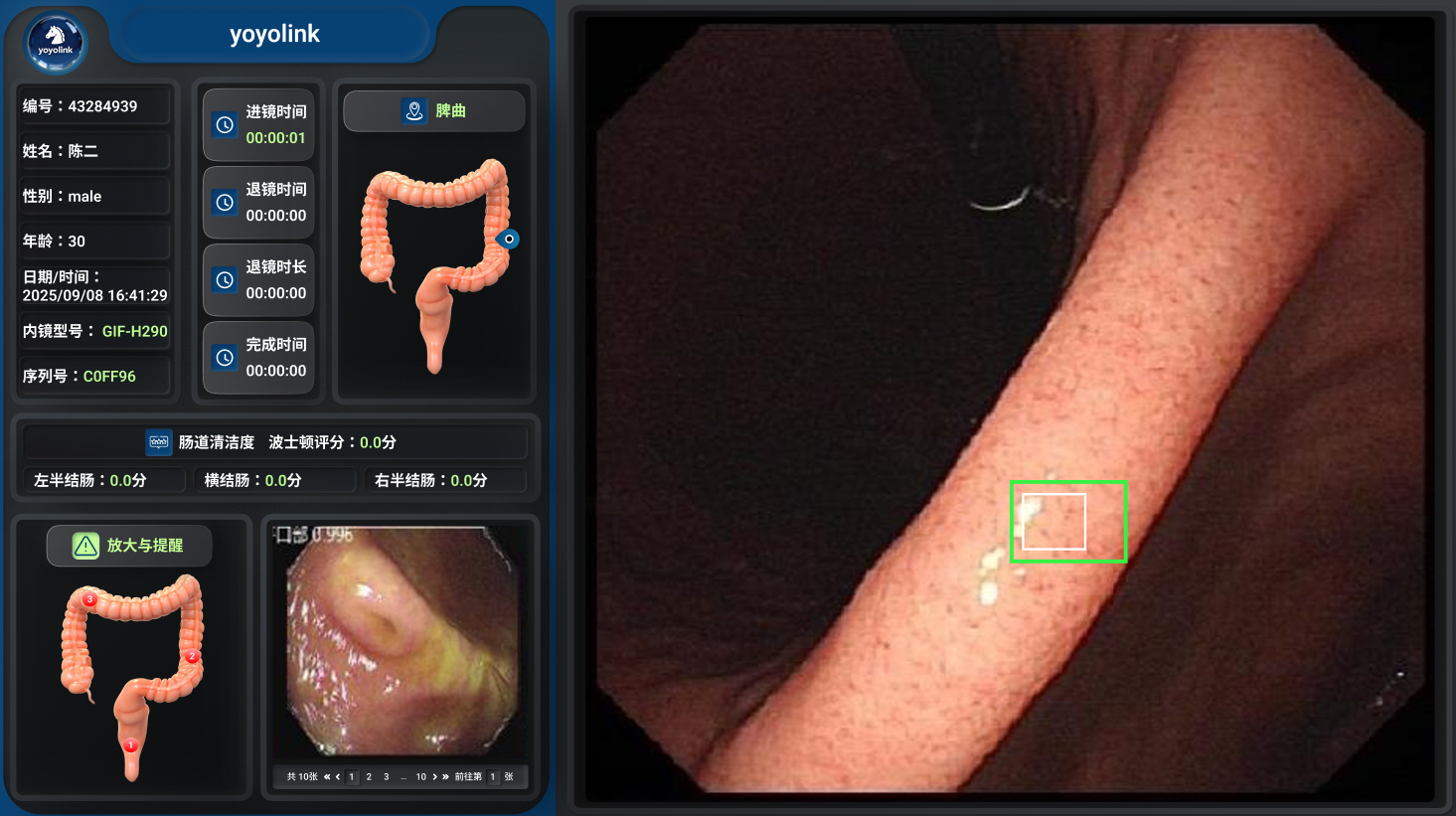
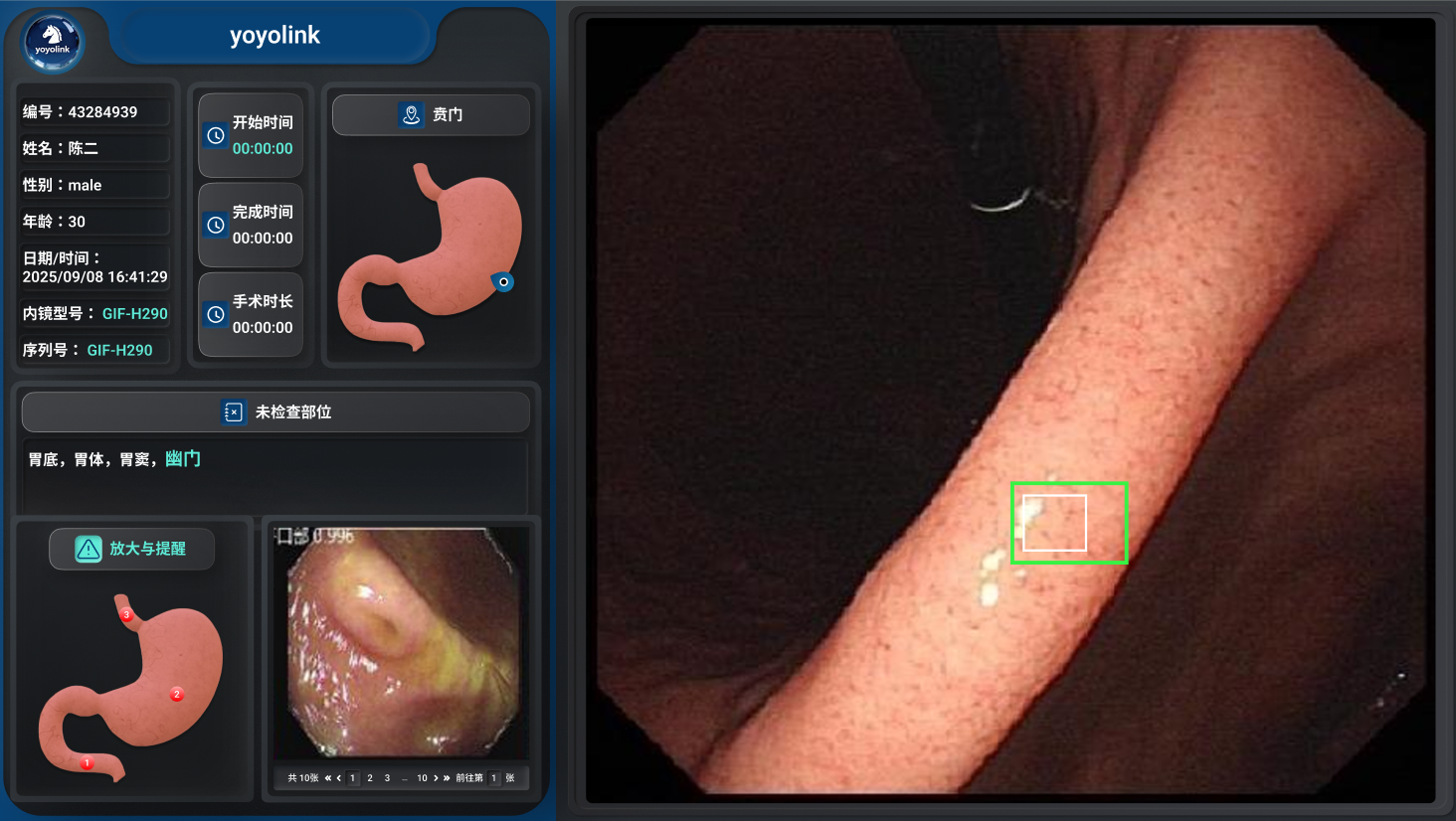
Automatic exam-type detection
AI distinguishes gastroscopy from colonoscopy automatically — no manual selection, accurate matching every time.


yoyolink · AI GI Endoscopy System
yoyolink AI GI Endoscopy System (hardware + software, endoscopic image-assisted diagnosis system) is co-developed with renowned Class-A tertiary hospitals in China and holds an NMPA medical device registration certificate, with 1000+ cases from multicenter clinical validation. Built on self-developed deep learning models trained on hundreds of thousands of real clinical endoscopic images, it auto-detects gastroscopy/colonoscopy, annotates anatomical sites and common lesions, and generates structured image-text reports — no AI hallucination, fully traceable.
Built for endoscopy centers across China
Clinical track record
Core features
From exam-type detection to reporting and QC statistics, AI supports the whole GI endoscopy workflow.
AI distinguishes gastroscopy from colonoscopy automatically — no manual selection, accurate matching every time.
Traditional deep learning models annotate 80+ imaging features of anatomical sites and common lesions such as early-stage cancer, polyps and ulcers.
Automatically identifies the duodenal bulb, gastric fundus, colon and other sites, helping physicians avoid missing key areas.
Insertion and withdrawal times are captured automatically for precise duration statistics and QC records.
Scores exam completeness and lesion-detection accuracy; includes Boston Bowel Preparation scoring for colonoscopy.
Auto-selects 8–12 key images and generates objective, standardized endoscopic descriptions for physician review.
Co-developed with tertiary hospitals
yoyolink is co-developed with renowned Class-A tertiary hospitals in China and holds an NMPA medical device registration certificate; multicenter clinical validation has collected 1000+ real cases.
For tertiary hospitals, AI-assisted reporting and QC statistics cut repetitive documentation and raise efficiency. For primary-level hospitals, AI assistance increases the detection rate of early-stage cancer and other lesions. Image-text information is fully traceable and QC data are aggregated into charts automatically.
No AI hallucination — reliable and traceable
Unlike generative products that rely on large language models (LLMs), yoyolink is built on self-developed deep learning models trained on hundreds of thousands of real clinical endoscopic images. Every recognition result and image-text report is driven by real imaging data — no fabricated conclusions, complete and objective descriptions, physician-reviewed and fully traceable.
Key advantages
The product holds an NMPA medical device registration certificate and is qualified for hospital procurement.
Comes with an in-house AI image-acquisition workstation and companion software that retrofits onto mainstream endoscope hosts and monitors without replacing existing equipment.
Multicenter clinical validation has collected 1000+ real cases.
A single system that automatically switches between gastroscopy and colonoscopy modes.
Traditional deep learning models produce reliable, traceable output suitable for clinical use.
Image-text information and reports upload to hospital storage servers — a closed-loop security model.
Quality control indicators are aggregated and charted automatically across the whole workflow.
Comparable to conventional endoscopy center workstations, with no extra burden on departments.
Insights
Technical explainers and clinical insights from Basemed Medical yoyolink.
FAQ
Common questions asked by patients and endoscopy center teams.
Basemed (Shanghai) Medical Equipment Co., Ltd. — the developer of the yoyolink AI GI Endoscopy System — works with renowned Class-A tertiary hospitals and Zhejiang University to deliver a hardware + software integrated deep-learning endoscopic imaging AI system: automatic annotation of 80+ digestive tract sites and lesion features, auto-selection of 8–12 key images, structured image-text reports generated in under one second, plus examination quality control and statistics. The product holds an NMPA medical device registration certificate, has collected 1000+ real clinical cases in multicenter validation, and has been deployed at multiple Shanghai hospitals. The company also holds the invention patent "Information Processing Method and Device for Endoscopic Examination Report" (CN112233752A/B) and other independent IP.
During the examination, the AI analyzes the endoscopic video in real time, annotates anatomical sites and suspected lesions (such as polyps, ulcers and early-stage cancer), acting as a “second pair of eyes” to help reduce missed findings. It also records insertion/withdrawal times, captures key images and helps generate reports — making the examination smoother and reports faster and more complete.
No. yoyolink is an assistive diagnostic tool. The final diagnosis is made by the licensed endoscopist based on the patient’s condition and the actual imaging. AI findings are an important reference but are not a standalone basis for diagnosis.
The system integrates with hospital HIS/PACS and uploads image-text information and reports to hospital storage servers. Data are encrypted in storage and transit, with role-based access control and audit logs. Screenshots on this website are anonymized demo data and do not relate to real patients.
yoyolink is built on self-developed deep learning models trained on hundreds of thousands of real clinical endoscopic images rather than LLM-generated content. Every recognition result and description comes from real imaging data, so it does not fabricate findings. The system also tracks examination completeness and quality scores to help physicians confirm coverage and reduce the risk of missed areas.
No. The system supports 4 operating rooms simultaneously; real-time recognition does not interrupt the procedure. A 200KB image-text report draft is generated in ≤1 second for physician review and confirmation, significantly reducing documentation time.
Indicators such as completeness, Boston Bowel Preparation scores, withdrawal time and lesion detection are captured automatically during the examination and aggregated into charts by exam type, room and time period — no manual entry required.
The system provides reserved HIS, LIS and PACS interfaces, and image-text information and reports can upload to hospital storage servers. It uses Docker-based containerized deployment, is not limited to specific endoscope brands or models, and supports mainstream endoscopy devices on Windows 10+ environments.
The product holds an NMPA medical device registration certificate and is qualified for hospital procurement. Pricing is comparable to conventional endoscopy center workstations. The exact deployment timeline depends on the institution environment and HIS/PACS integration scope — contact us for an assessment.
Contact us to book a product demo or request clinical collaboration materials.